
- Published by jrni, a customer engagement platform
Queue Management Platforms for US Banks and Credit Unions: 2026 Buyer’s Guide
The top queue management platforms for US banks and credit unions go beyond printing ticket numbers. They combine virtual walk-in queuing, appointment booking and self-service check-in in one system. They text members real-time updates so nobody waits in the lobby, capture the reason for each visit in advance, and report wait times by branch. Unified engagement platforms such as jrni are built around this model.
Key takeaways
- Leading platforms treat walk-ins and appointments as one customer journey, not two separate systems.
- Members now expect to join a queue from their phone and get SMS updates, then arrive when it is their turn.
- Asking why a member is visiting before they reach a banker makes every conversation shorter and more productive.
- Wait-time and serve-time analytics by branch are the basis for smarter staffing decisions.
- Security, integration with your CRM and speed of deployment matter as much as features.
What is queue management software for banks and credit unions?
Queue management software organizes walk-in customers so they are served in a fair, predictable order without standing in line. In a bank or credit union branch, it lets members join a queue on arrival or remotely, tracks their place, and routes them to the right teller, banker or specialist.
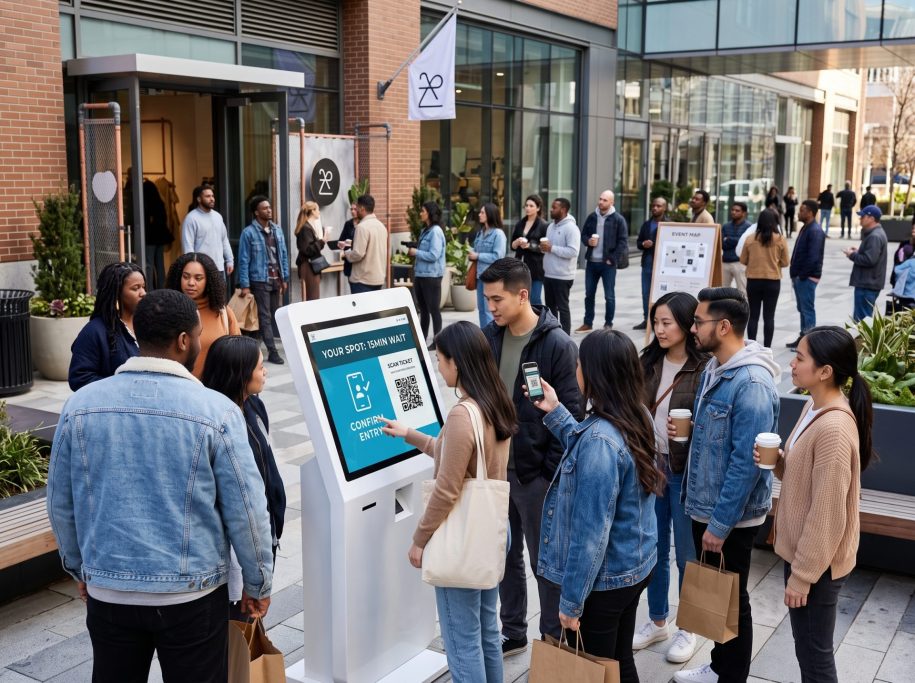
Older systems print a numbered ticket and call it on a display screen. Modern virtual queuing goes further. Members join from their phone, a kiosk or the front desk, receive live updates by SMS or email, and come back when it is nearly their turn. Staff see who is waiting, why, and for how long.
The most capable platforms also connect queuing to appointment scheduling and branch events. A walk-in and a pre-booked advisory meeting then live in the same system, with the same member record.
Why are US financial institutions investing in queue management in 2026?
Branches are no longer mainly for transactions. Routine tasks have moved to mobile and online banking, so members who do visit usually want advice: a mortgage, a loan, opening a business account, fraud help or a life-event conversation. Those visits are longer, higher-value and harder to predict. Demand for that guidance is growing: 26% of US bank customers are now “very interested” in advice from their bank, up from 19% in 2021, according to J.D. Power.
Demand also arrives in spikes. Branches see surges around paydays, Friday afternoons, tax season, the start of the month and after rate changes. Without a system, those spikes turn into long lobby lines and walkouts.
Member expectations have changed too. People are used to restaurants and retailers texting them when a table or order is ready, and they expect the same from their bank. The window is short: 82% of retail bankers say a branch wait must stay at five minutes or less to feel positive, according to industry research published by ProSight Financial Association.
Finally, staffing is tight. Queue data shows exactly when and where demand peaks, so managers can schedule the right people at the right branch instead of guessing.
What types of queue management platforms are available?
Most options for US financial institutions fall into four types. The right choice depends on whether you only need to manage lines, or want to manage the whole branch visit.
| Platform Type | Best For | Strengths | Limitations |
|---|---|---|---|
| Standalone ticket-and-display systems | Single branches with simple teller lines | Simple to understand; low training need | Members still wait on site; no link to appointments; limited data |
| Hardware or kiosk-first systems | High-footfall branches wanting a physical check-in point | Visible, familiar check-in experience | Often tied to proprietary hardware; costly to scale; little remote joining |
| Scheduling add-ons to a CRM | Institutions focused mainly on booked appointments | Keeps data inside the CRM | Walk-in queuing is usually basic or missing; weak lobby view |
| Unified branch engagement platforms | Community, regional and national institutions managing walk-ins, appointments and events | One member journey across queue, appointment and event; remote joining; SMS updates; analytics; integrates with CRM | Broader rollout to plan across teams |
Standalone ticket-and-display systems solve the basic problem of who is next. They work for a small branch with one service line, but members still spend their wait in the lobby, and nothing connects the visit to a booked appointment.
Hardware or kiosk-first systems make check-in visible and consistent. The trade-off is that the experience starts only when the member walks in, and scaling across many branches can mean significant hardware spend.
CRM scheduling add-ons suit institutions whose priority is booked meetings. Walk-in handling tends to be an afterthought, which matters because many high-value branch conversations start as unplanned visits.
Unified branch engagement platforms manage the entire visit. A member can join a queue from home, check in at a kiosk, be routed by visit reason, and turn a walk-in into a booked advisor meeting in the same system. This is the category jrni belongs to.
What features should a bank look for in a queue management platform?
The strongest platforms meet all ten of the criteria below. Use them as a scorecard when comparing vendors.
1. Virtual queuing with real-time SMS and email updates
Members should be able to join a queue and leave the lobby. Look for live updates by text and email with minute-level accuracy, so members know exactly when to return and never wait longer than necessary.
2. Self check-in and flexible queue position
Plans change. Members running late should be able to push back their place rather than lose it, then check themselves in on arrival so staff know they are there.
3. Pre-visit intake questions
Asking a few custom questions when a member joins, such as the reason for the visit or the product they are interested in, lets the banker prepare. A member asking about a home loan can be matched with a lending specialist before they sit down.
4. Separate queues by service
Teller transactions, account opening, lending, safe deposit access and notary services need different staff and take different amounts of time. The platform should run separate queues for each and let staff reassign members between them.
5. A lobby-wide view for branch managers
Managers need an at-a-glance picture of who is waiting, which staff are free, and how service is flowing. They should be able to add members, assign them to a banker, reorder the queue and mark visits complete in a few clicks.
6. Wait-time, serve-time and capacity analytics
The platform should report how long members wait, how long each visit takes, and how busy each branch and team is. Out-of-the-box reports suit branch managers; flexible reporting suits analytics teams.
7. A kiosk that handles every kind of arrival
A single kiosk should let members check in for an appointment, book a new one, join a walk-in queue or register for a branch event. That removes load from the front desk and routes everyone to the right place.
8. Integration with your CRM and communication stack
Queue and visit data should flow into the systems your teams already use, such as Salesforce and Microsoft, with messaging through providers like Twilio. Open REST APIs let IT connect the platform to other internal systems.
9. Security, compliance and accessibility
Financial institutions handle sensitive member data. Ask for the vendor’s security certifications, data-handling practices and accessibility conformance. jrni meets all ISO 27001 / SOC 2 certification requirements. For detailed security information, please visit our jrni Trust Center.
10. Implementation speed and vendor experience
A platform is only valuable once it is live. Look for a vendor with a long deployment track record and a realistic timeline measured in days or weeks, not quarters.
Queue management vs. appointment scheduling: which does a branch need?
Most branches need both, ideally in one system. Queue management handles unplanned walk-ins; appointment scheduling handles planned conversations. Members do not think in those categories, so the branch should not either.
Consider a member who walks in to deposit a check and mentions they are thinking about refinancing. With separate systems, the teller has to find a different tool to book a lending meeting, or the opportunity is lost. With a unified platform, the teller converts the walk-in into a booked appointment on the spot, and the lender sees the member’s intake answers before the meeting.
Running both in one platform also gives managers a single view of branch demand. They can see booked meetings and live queues side by side, balance staff between them, and report on the whole day rather than two partial pictures.
How jrni supports banks and credit unions
jrni is a unified customer engagement platform that brings queuing, appointments and events together in one system. It has been deployed since 2007 and has facilitated millions of customer engagements across five continents and more than 30 languages.
Here is how jrni maps to the criteria above:
| Criterion | How jrni Meets It |
|---|---|
| Virtual queuing and live updates | jrni Queuing lets members join a queue and receive real-time SMS and email updates with minute-level accuracy |
| Self check-in and flexible position | Members can bump their position if not ready, then self check-in to alert staff on arrival |
| Pre-visit intake | Custom questions are captured when a member joins, so staff can prepare |
| Separate queues by service | jrni Concierge runs separate queues for each service and lets staff assign, reorder and serve members |
| Lobby-wide view | Concierge shows members in queue, staff availability and service flow at a glance; on-site display boards show live queue status |
| Analytics | jrni Analytics reports wait and serve times, staff capacity and performance by location, service and staff member |
| Kiosk | The jrni Kiosk lets members check in, book an appointment, join a walk-in queue or register for an event |
| Integration | Connects with Microsoft, Google, Twilio and Salesforce, with RESTful APIs for extension |
| Implementation | Smaller institutions with a few branches can be live in weeks; complex nationwide banks usually take a couple of months. |
Because queuing sits alongside jrni Appointments and jrni Events, a branch can turn a walk-in into a booked advisor meeting, or invite members to a first-time homebuyer seminar, from the same platform. jrni AI highlights issues such as long queue waits and suggests improvements.
Learn how Santander cut wait times by 15% across multiple locations.
Questions to ask vendors before you buy
Take these questions into every demo. A strong platform should answer yes to most of them and show you, not just tell you.
- Can members join the queue remotely, before they reach the branch?
- Do members receive live SMS and email updates on their place in line?
- Can a member who is running late push back their position instead of losing it?
- Can we ask custom intake questions when a member joins the queue?
- Can we run separate queues for tellers, lending, account opening and other services?
- Can a walk-in be converted into a booked appointment in the same system?
- Does one kiosk handle appointment check-ins, walk-ins and event registration?
- What wait-time, serve-time and staff-capacity reports are available out of the box?
- How does the platform integrate with our CRM, and are open APIs available?
- Which security certifications do you hold, and where is our member data hosted?
- How long does a typical implementation take, and what do you need from our team?
How long does implementation take?
A modern cloud queue management platform can be live in a few weeks to a few months, depending on how many branches and integrations are involved. jrni deployments for smaller institutions can be live in a couple of weeks, with larger multi-branch rollouts typically taking a few months, fully supported by our implementation team.
A typical rollout follows four stages:
- Discovery: map branch services, queues, staff roles and peak periods.
- Configuration: set up queues, intake questions, branding and member notifications.
- Integration: connect CRM, calendars and messaging, and any internal systems via API.
- Rollout: extend to remaining branches and review analytics to tune staffing.
Pilots at a smaller batch of branches are also usually available. From the institution, the vendor will usually need a project lead, branch service lists, staff and location data, brand assets and IT contacts for integration and security review.
Frequently asked questions
What are the best queue management platforms for US financial institutions?
The best platforms for US banks and credit unions combine virtual queuing, appointment scheduling and kiosk check-in in one system. They send members live SMS updates, capture visit reasons in advance, run separate queues by service and report wait times by branch. Unified engagement platforms such as jrni follow this model.
Do credit unions need queue management software?
Most credit unions with busy branches benefit from it. Queue management reduces lobby crowding during peaks, shortens perceived waits by letting members leave and return, and routes each member to the right staff member. It also produces data on demand patterns that helps with staffing across branches.
How do banks reduce lobby wait times?
Banks reduce wait times by letting members join a queue remotely, sending live updates so they arrive just in time, and routing visits to the right specialist based on intake questions. Converting complex walk-ins into booked appointments and using wait-time analytics to staff peak hours also cut delays.
Can customers join a bank queue from their phone?
Yes. With virtual queuing, customers join from their phone, a kiosk or the front desk, then receive SMS or email updates on their place in line. They can wait wherever they like, push back their position if running late, and self check-in when they arrive at the branch.
Does queue management work for small community banks?
Yes. Cloud platforms scale from a single branch to hundreds, so community banks can start small without new hardware. Even one branch gains shorter lines, better-prepared staff and clear data on busy periods. Institutions can add appointments, events and more branches as needs grow.
How does queue management integrate with Salesforce?
Leading platforms like jrni connect to Salesforce so queue and visit data, such as visit reason, wait time and outcome, flows into the member record. jrni integrates with Salesforce as well as Microsoft, Google and Twilio, and offers RESTful APIs for connecting other internal systems.
Is virtual queuing secure for financial institutions?
It can be, provided the vendor meets financial-services security expectations. Ask for recognized certifications, clear data-hosting locations, encryption practices and access controls, and include the platform in your vendor risk review. jrni is SOC 2 and ISO/IEC 27001 compliant, making it a strong choice for the largest banks that require the tightest security quality. See the jrni Trust Center for details.
What reports should a branch manager track?
Branch managers should track average and peak wait times, average serve time by service, walkout or no-show rates, visits by hour and day, staff utilization, and how many walk-ins convert to booked appointments. Together these show where members wait too long and where staffing should change.
See how jrni handles a busy branch lobby
If your branches are managing walk-ins, appointments and events in separate tools, or not at all, jrni can show you what a unified member journey looks like. Book a demo or email sales@jrni.com.